From the Blog

When Olympia, an expectant gorilla mom at Woodland Park Zoo in Washington state, needed specialized pregnancy care, the zoo turned to an unusual team of experts: clinicians more accustomed to caring for human mothers and babies.
Suzanne Peterson, M.D., a maternal-fetal medicine specialist, and Nichole Hamilton, a sonographer, of Maternal-Fetal Medicine Specialists of Puget Sound, part of Pediatrix® Medical Group, along with Emily Norland, M.D., chief obstetrician-gynecologist at Swedish Medical Center, were invited by Tim Storms, DVM, director of animal health at Woodland Park Zoo, to help monitor Olympia's pregnancy alongside Sachita Shah, M.D., a sonographer with Butterfly Network. Their collaboration with the veterinary and animal care teams ultimately led to a historic delivery: the first gorilla born via C-section in the zoo's 126-year history.
Gorilla C-sections are extremely rare, with fewer than a dozen performed globally. Once Olympia's baby boy was delivered, Andrew Beckstrom, M.D., a neonatologist at Pediatrix® Neonatology of Northern Puget Sound, provided specialized intensive care as the Pediatrix team and zoo medical staff worked together to support both mom and baby.
Monitoring a Gorilla Pregnancy
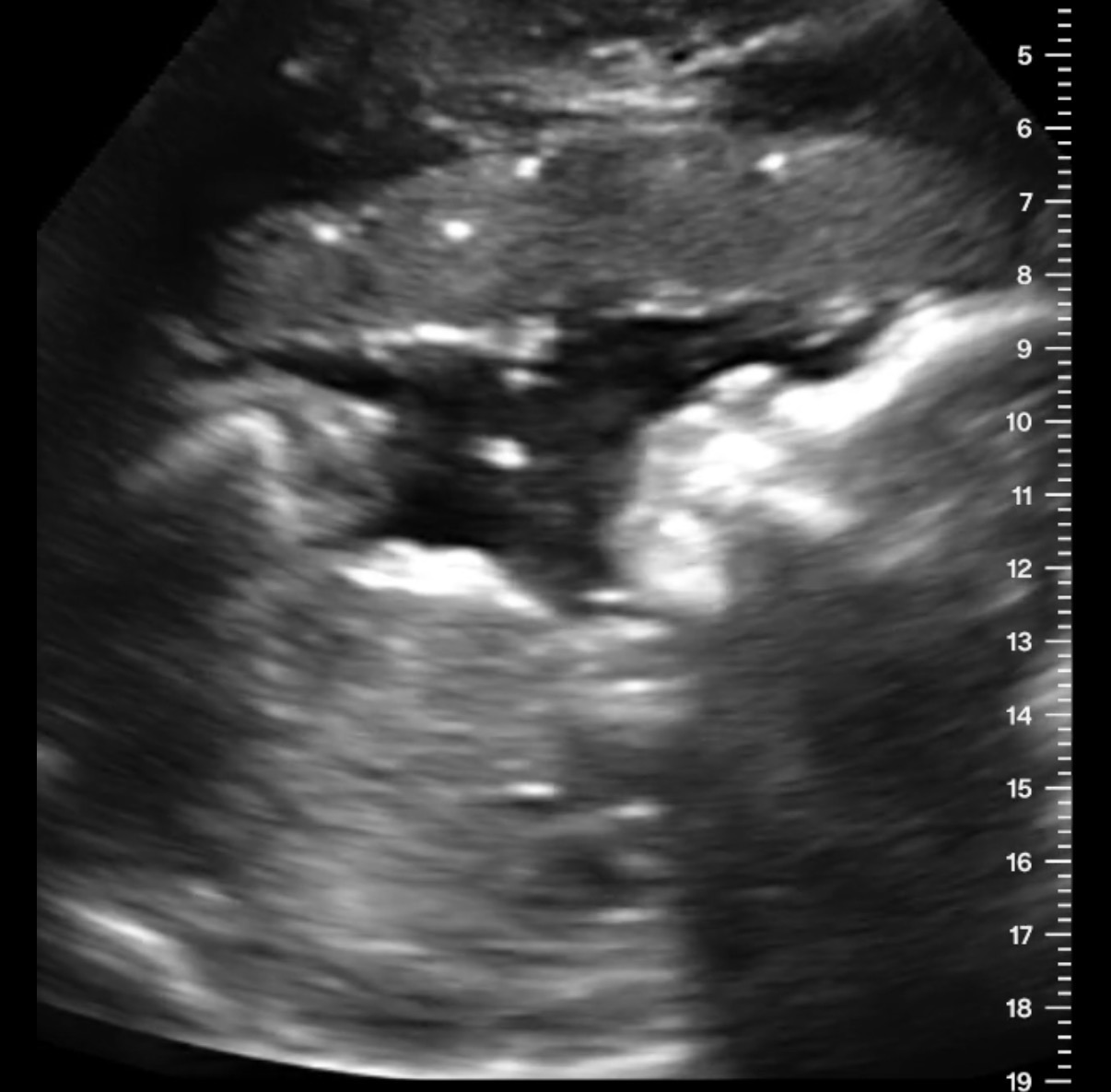
After Dr. Peterson met with Dr. Tim Storms and the rest of the zoo team, they decided to perform ultrasounds about every two weeks to monitor the wellbeing, development, growth and anatomy of Olympia's baby.
"I immediately involved Nichole in this, in part because of her amazing skill and also in part because of her affection towards animals and veterinary work," said Dr. Peterson. "It was an obvious choice for me to have her help with imaging."
The gorilla moms are trained to voluntarily come to a mesh opening that allows the team to perform an ultrasound in a challenging position, essentially sitting on the ground and scanning from underneath them during a brief window of imaging opportunity. Every two weeks, the team looked first for fetal heart tones, confirmed there was an adequate amount of fluid, assessed the placenta and obtained whatever images they could.
Dr. Peterson and Nichole were able to capture some remarkable heart views when the window of opportunity allowed. "There was one day in March when I got an amazing profile that anyone looking at it would think it was a human profile," said Dr. Peterson. "We had the benefit of using the Butterfly ultrasound and Dr. Shah came with us, and that was really helpful in terms of being able to obtain really fabulous images."
"It was kind of amazing to me how similar they were," said Nichole. "There were times when I was able to get the cord insert, I could see the bladder and I got a whisper of kidneys."
The imaging depended heavily on the baby's position because Nichole's window to scan was very small. Unlike scanning a pregnant human person lying on an exam table, she did not have the ability to reposition freely or obtain the full range of angles she typically would.
"I had a very ergonomically unfriendly position to scan them," said Nichole. "It was a very hairy body blocking my ability to make contact with the skin, so there's a lot of attenuation with the ultrasound and the depth that I'm going to is much bigger than on a human. It was lovely those tiny windows in which the baby rolled, and I was able to see a four-chamber heart. We got profiles and practice breathing. The fleeting moments where we were actually able to show these things were pretty amazing."
When Monitoring Turned Urgent
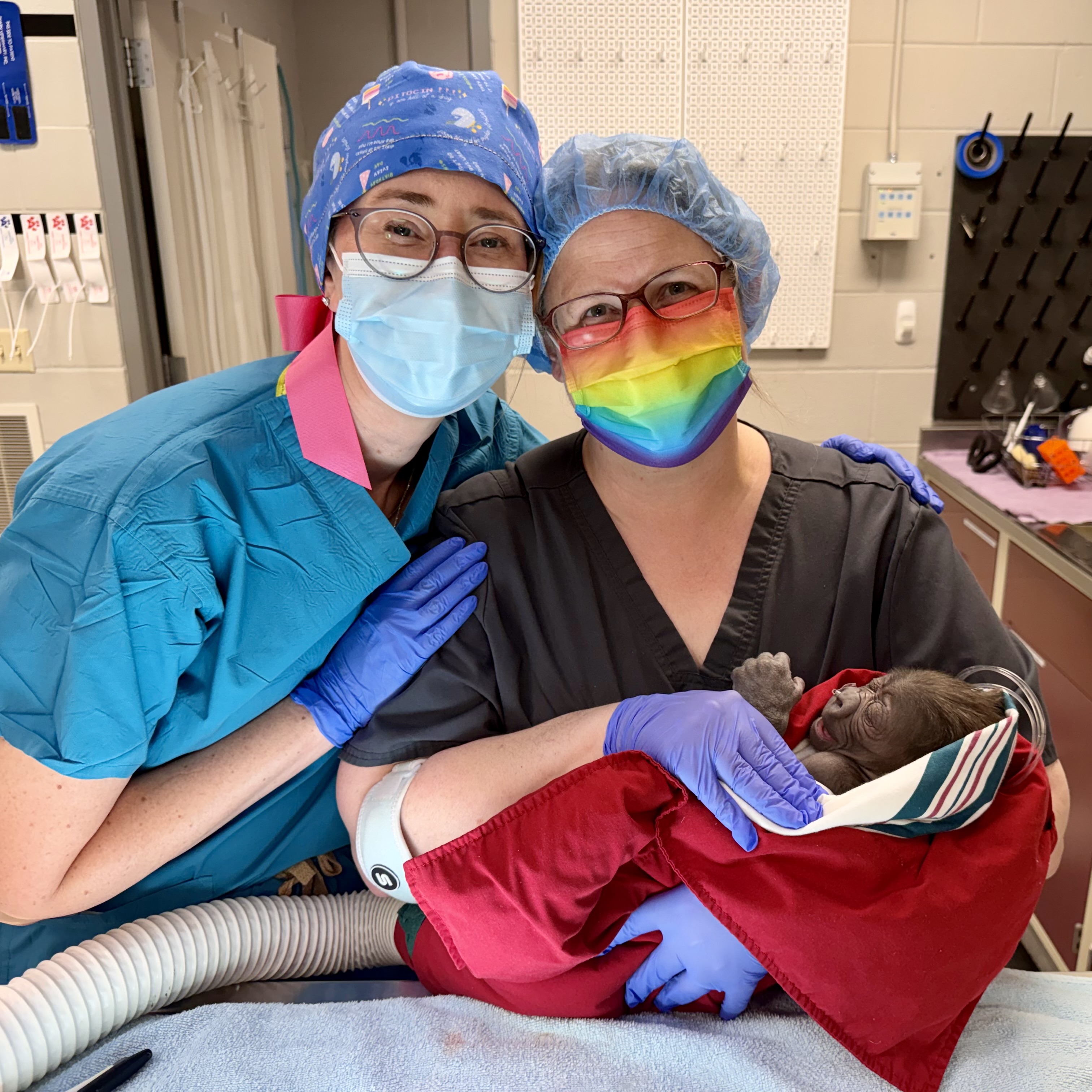
A gorilla pregnancy lasts about 36 weeks, roughly a month shorter than a human pregnancy, and Olympia had already entered the period of closer observation around her due date.
"We knew Olympia was a little overdue, and so Dr. Storms requested that we monitor her a little bit more closely," said Dr. Peterson. "There were two big things that happened that kind of pushed us to collaboratively move forward with an anesthetized exam so that we could better evaluate Olympia and her baby."
On the Friday before Memorial Day, the team noted low fetal heart tones and began to monitor the fetal heart rate more closely. Then, on Sunday of Memorial Day weekend, there was no fluid around the baby.
"Those two things indicated to us that potentially she had ruptured her amniotic sac, that potentially she had gone into labor, and that the placenta might not be doing everything it needed to do to support the pregnancy," said Dr. Peterson. "So, we were in a window of opportunity where we felt like we needed to push to delivery and when the baby gorilla still looked good on the monitor."
As the team processed the situation, they found that there were more similarities than differences between caring for Olympia and caring for a human obstetric patient. Once Olympia was anesthetized, they were able to check her cervix. She was only two centimeters dilated, the amniotic sac had ruptured and she was thus not a candidate for an operative vaginal delivery, so Dr. Storms and the consulting team determined a C-section was needed.
"For all practical purposes, the C-section was very, very similar to what we would do in a human," said Dr. Peterson. "I would say there are a couple big differences. Number one is the dermis, or the skin. The gorilla is a lot thicker, so it felt like we were cutting through callus. The other difference is that the pelvis of the gorilla is a little bit different and the caliber of the bowel is different, so when you open you have a lot more bowel to pack away."
"But I would say that if you're just going to look at the ovaries, the uterus and the tubes, an obstetrician would say that they looked exactly like a human," said Dr. Peterson. "We share over 98% of our genetic material with gorillas, so when we were doing that part of the procedure, it felt like we were operating on a human."
The team made a slightly different incision on the uterus than they would for a human patient because of the shape of the uterus, but the rest of the surgical techniques were very similar. At the end, they used smaller segments as they closed the strong layer of fascia and then the skin, taking care to hide the knots so Olympia would not pick at them. They also used additional layers and segments to help ensure the incision would withstand the movement they expected postpartum.
"Once they took her back to her habitat at the zoo and she woke up, she started climbing immediately and we were just crossing our fingers that our incision was going to be strong enough to hold all the activity that we knew she was going to do after we delivered her," said Dr. Peterson. "She did very, very well."
Caring for a Newborn Gorilla
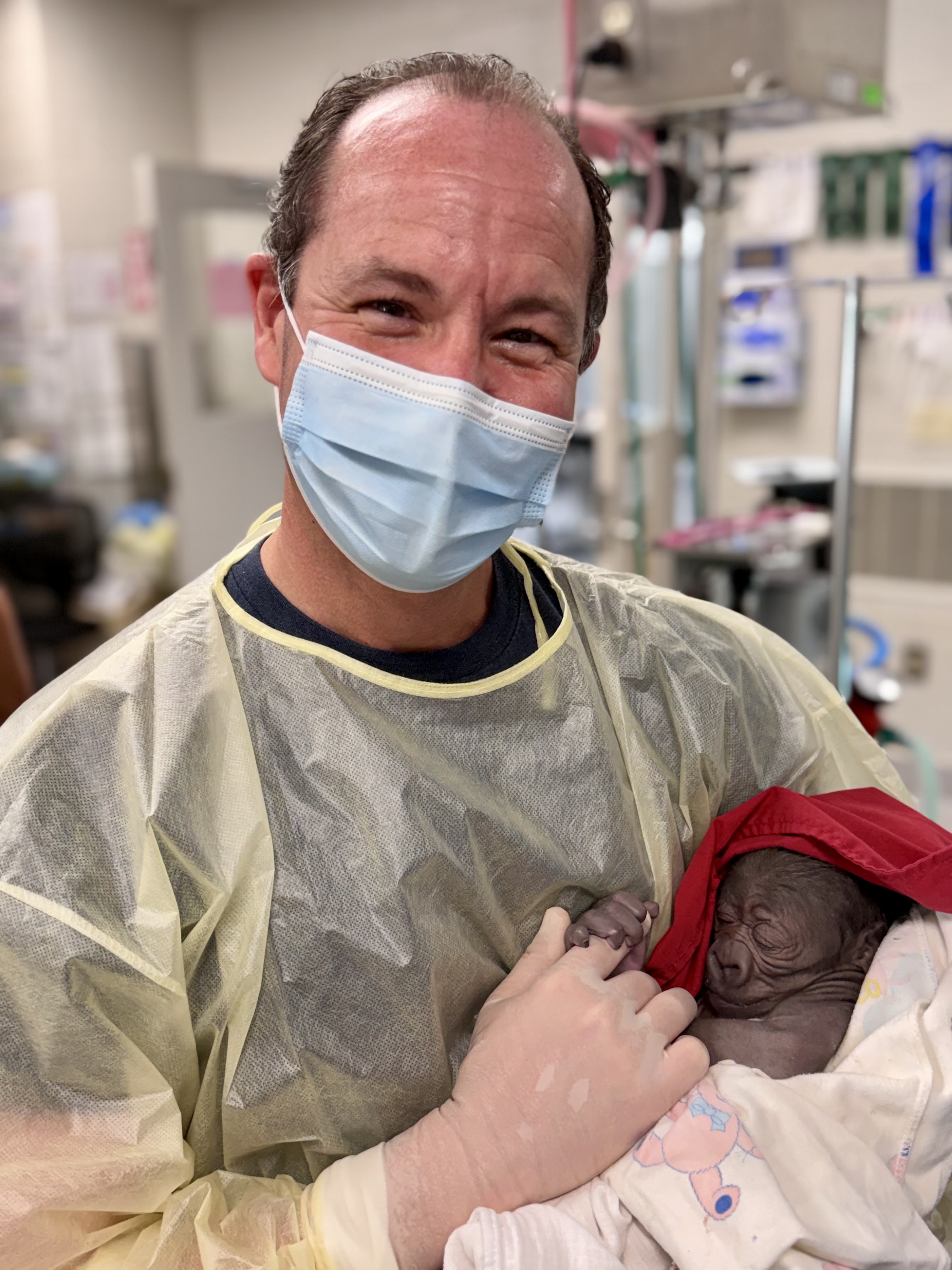
Dr. Beckstrom was scrubbed and ready to receive the baby once he was delivered, along with Drs. Storms and Shah.
"Knowing that the baby was exposed to so much anesthesia leading up to the delivery process, we knew the baby would have some significant respiratory suppression, likely all done by us to safely deliver him, but that was going to be the situation nonetheless," said Dr. Beckstrom.
The baby was quickly brought to the resuscitation table and as expected, the baby had primary apnea. Dr. Storms administered a planned anesthetic reversal agent, which helped to reduce the apnea. Dr. Beckstrom then followed a standard neonatal resuscitation program to help transition the baby. The team warmed him, dried him off and, most importantly, provided additional breaths until the anesthesia cleared. They were prepared for intubation if needed, but because the respiratory suppression was expected to be temporary, they used bag-mask ventilation until he began waking up. It took about 10 minutes for him to wake up and begin interacting with the team. Then he became sleepy again during secondary apnea, and the team supported him with additional breaths until he fully transitioned.
"The whole transition process was probably about half an hour, from start to finish," said Dr. Beckstrom. "He did well. There were so many similarities [to caring for a human neonate] – warming him up, stimulating him and getting him going. The two big differences that I think neonatologists would find interesting is we spend so much of our time in the delivery room focusing on the Apgar scores, the metric we use to help identify and communicate how well the baby transitions right at the beginning and then five-ten minutes later. With this little kiddo, two out of five of our Apgars were not usable."
For a human newborn, clinicians often use color and respiratory effort or crying to assess transition. With a baby gorilla covered in hair and with darker skin, color could not be assessed in the same way. Respiratory effort was also different because the baby was not expected to cry.
Once the baby woke up, he was looking around but not making big cries, so Dr. Beckstrom asked the gorilla keeper if that was normal. She explained that in the wild, a baby gorilla would not cry because doing so could attract predators to a newly postpartum mom and baby in a vulnerable state.
"Those were the two big differences, but the majority of the transitional and resuscitation process is everything that you would expect a baby exposed to general anesthesia in the operating room to kind of go down that road," said Dr. Beckstrom. "By the next day, he was able to reunite with the gorilla troop, and they were able to make things work."
A Team Effort Across Disciplines and Species
Reflecting on the experience, the team felt that the collaboration they rely on every day in human medicine had been transplanted to Woodland Park Zoo.
"We work together in an interdisciplinary way at Swedish Medical Center every single day and all of us know each other really well," said Dr. Peterson. "I've worked with Dr. Beckstrom for almost 20 years and the same with Dr. Norland. I met them both when we were in fellowship together at the University of Washington. I've handed off so many babies to Dr. Beckstrom that there are times that we don't even have to speak, we can say 'hey, I'm worried about this' with our eyes. And so, that part was amazing. To be with a team that you feel so comfortable with – there's a lot of gratitude for that."
"It was very humbling to be invited by the zookeepers and Dr. Norland to be a part of this," said Dr. Beckstrom. "We are all very accomplished in our careers, but to be asked to be part of such an important and incredible experience was just humbling and wonderful. To know that there is a baby gorilla from an endangered species that is now thriving at Woodland Park Zoo and we were a part of that is just beautiful."
For Dr. Peterson, the experience also offered a new kind of interdisciplinary connection: one that was interspecies.
"We were working really closely with the zookeepers who are literally liquid gold at the Woodland Park Zoo," said Dr. Peterson. "They are with this troop and these moms and babies on a daily basis, feeding them and training them. Working with them and the veterinary team was really seamless. It was a true team approach and I loved that part – I think it was really special for all of us. It's one of those grounding experiences that we will never forget."
The latest from the Blog

Attend Our Next NEO and OB Grand Rounds
From the Blog

